Did you know? Change is happening

February 23, 2008 by


V is for Vader – Rewriting the Star Wars Prequels

December 29, 2007 by

I have seen lots of bad movies in my life. Most of them are soon forgotten. But only one film betrayed me to such a degree that I continue to think about it years later. I am speaking of coarse of the ruination of Star Wars with the prequels (yes, I can be that much of a geek sometimes). Fixing these stories is the subject of hundreds of fan made YouTube videos and thousands of webpages, so at least I’m not alone. I shutter to think of hours that have been spent as fans discuss what it was that made Star Wars jump the shark. Was it Jar Jar? Midi-chlorians? Or was it Lucas lavishing attention on special effects and zipping around the galaxy trying to squeeze as many creatures, star ships, Jedi, planets, and cities into the movie as possible while leaving plot, character development, acting, and dialog as a mere after-thought? I think we all know the unfortunate answer to that question. Read more » »


Is the open source community capable of innovation?

December 11, 2007 by

The Linux community has done a good job of copying Windows. Open Office does a pretty good job of copying Microsoft Office. Now there are open source versions of YouTube and MySpace. But where is the innovation? Firefox and its multitude of plugins seems to be the one exception. Meanwhile, companies like Apple – a company that is incredible closed, and secretive has created one innovative product after another. Why is this?

  • Do too many cooks spoil the open source stew and lead to a natural conservatism?
  • Do people save their really good ideas for patents, copyrights, and ultimately some plan for profit?
  • Is the open source community not as dedicated (since I’m guessing it is not their full time job to write free software)?
  • Is the open source community not as talented? Has Microsoft, Apple, and Google hired away all the talent?
  • Is it a resource issue?
  • Or is there some other flaw with how open source works that stifle innovation?

I have been looking at how communities like digg, slashdot, wikipedia, and other smaller forums operate. There does seem to be a conservative nature to large crowds. Mainly because the urge to contribute is high. So high, that people want to comment or tweak something even if they have no real expertise. Another issue is that as soon as some one mentions a novel or creative idea, there are 50 people eager to chime in with why its a bad idea. The burden then falls on the innovator to defend their idea. Without sources or previous examples they can cite (we are talking about innovation after all), the idea simply drowns beneath an ocean of criticism. Anyone surveying the discussion will conclude the idea was shot down.

This is all just speculation on my part. It will take more than just a few case studies to uncover any true underlying pattern.


The future of social networks

December 5, 2007 by

It seems there are new social tools created everyday. So I had a few questions:

  • How long does it take for these networks to reach critical mass?
  • What happens when the market is saturated?
  • How many networks are people willing to invest time into?
  • What’s next for them?

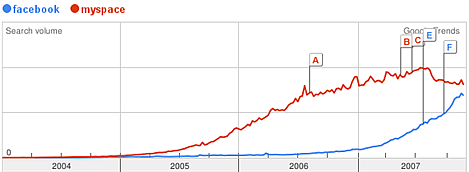
To answer the first question I went to Google trends and plotted MySpace versus Facebook.

From this it looks like myspace has peaked and facebook is nearly as popular now. Next I went to alexia.com which ranks sites. Read more » »


End User Agreements – Stealing customer rights with a sneak attack in the fine print

November 29, 2007 by

Recently I have become more aware of the many “agreements” that companies use to try and take away the rights of users (and protect themselves from any liability). Almost every activity in this increasingly digital and legalistic world comes with attached fine print that tries to absolve the company of potential bad behavior. When you sign your credit-card slip at Best Buy or Fry’s, you waive all kinds of rights you get under consumer protection law. Of course if you actually stop to read these agreements, it is likely that your session will expire if your online or if your in the checkout line at Target the clerk will likely call the manager or even the police after the first hour or so of haggling (everyone should do this at least once a year – then they would stop doing it I’d wager). It would literally take all day to read, and ask questions (none of which the store clerk would be able to answer) about all the agreements in an average customers shopping cart. Since reading them all is not practical, and understanding them not possible, and negotiating them is NEVER possible – what to do? What’s the point of having rights (like fair use) if they can, and are, so easily swindled away? Read more » »


« Previous PageNext Page »